How to Prove Fault in Distracted Driving Motorcycle Accidents in Ohio
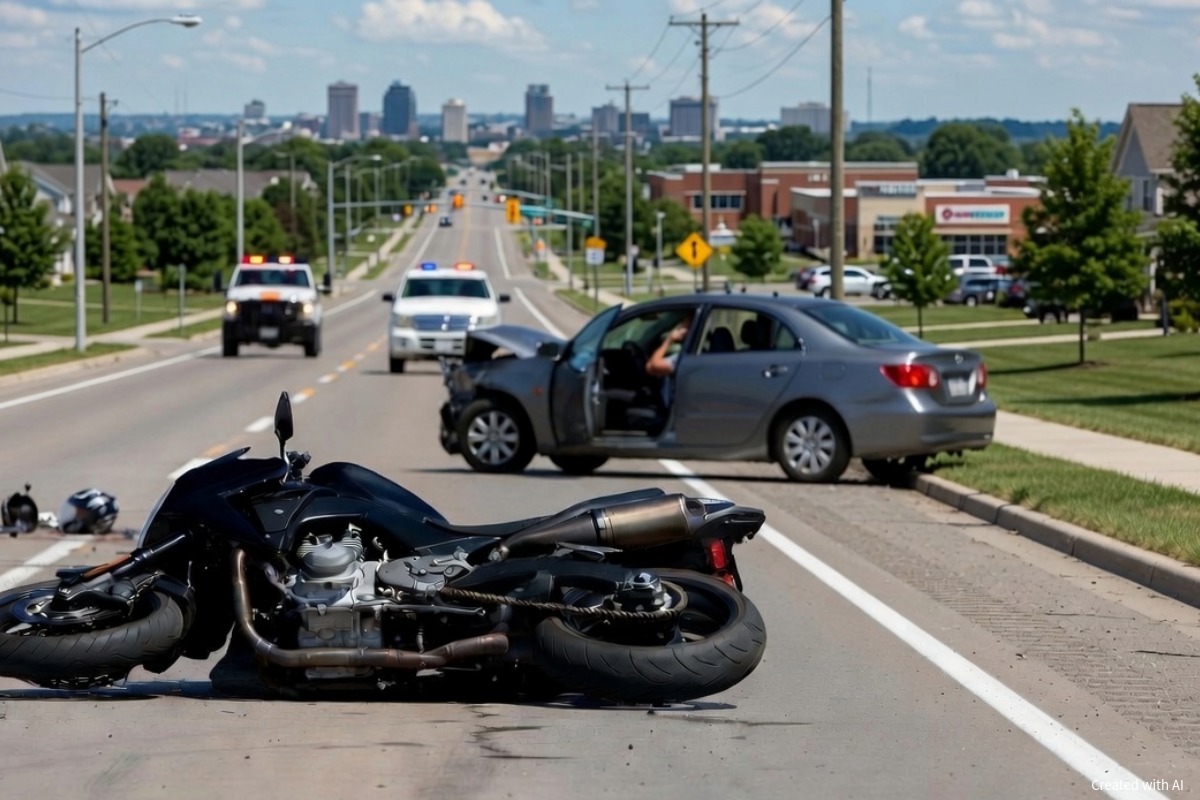
The Ohio State Highway Patrol tracked more than 48,000 crashes involving a distracted driver between 2021 and 2025. Motorcyclists absorb a disproportionate share of that damage—the NHTSA reports that riders are 27 times more likely to die in a crash than someone in a passenger car, mile for mile.
If a distracted driver caused your motorcycle crash in Ohio, the central challenge is proving it. You may have seen the other driver holding their phone, or a witness may have told the responding officer about it, but the gap between knowing a driver was texting and proving it in an insurance claim or courtroom is where cases are won or lost.
Read on as we break down why motorcyclists face a higher risk from distracted drivers on Ohio roads, what evidence you need to prove the other driver was on their phone, and what steps to take in the first hours after a crash to protect your claim.
Why Are Motorcyclists More Vulnerable to Distracted Drivers?
A motorcycle takes up a fraction of the lane space that a car does; at 60 mph on I-71 or I-75, a rider occupies a visual footprint smaller than a single headlight on an SUV. Per NHTSA’s own research, the majority of multi-vehicle motorcycle crashes happen because the other driver failed to see the rider.
Cognitive scientists have a term for this: inattentional blindness. Your brain filters the road for what it expects to find, and motorcycles do not rank as high on that list as cars, trucks, and SUVs. A rider merging at I-270 or crossing a busy Columbus intersection can be in plain sight and still go unregistered by a driver whose brain is scanning for larger vehicles.
That detection gap gets worse when the driver is on their phone. According to NHTSA, scrolling through a text takes a driver’s eyes off the road for about five seconds. At 55 mph, that covers the length of a football field. A motorcycle that was 300 feet ahead when the driver looked down could be right beside them when the driver looks up, and the driver’s brain never had a chance to register it.
How Do You Prove the Other Driver Was Distracted?
Proving distraction in a motorcycle accident requires specific evidence, not just your word against theirs. The other driver’s insurance company will fight hard against any claim that their driver was on a phone, because clear proof of distraction means a bigger payout. Here are the types of evidence that carry weight.
Can Cell Phone Records Prove the Driver Was Texting?
Yes. Your attorney can subpoena the other driver’s cell phone records from their carrier. Those records show the exact time of outgoing texts, incoming messages, and data usage. If the records show the driver sent a text at 4:47 p.m. and the crash happened at 4:47 p.m., the timeline speaks for itself.
However, this process takes time. Carriers hold records for limited periods, and getting them requires a legal request called a subpoena. The sooner your attorney sends a written notice to the other driver and their insurance company demanding they preserve phone data, the less likely that evidence will disappear.
What Role Does the Police Report Play?
Ohio officers document driver behavior in their crash reports. If the responding officer noted phone use, distraction, or wrote a citation under ORC § 4511.204, that report becomes one of the strongest pieces of evidence in your case. Officers sometimes note whether a phone was found in the driver’s hand or lap at the scene.
How Do Witnesses and Dashcam Footage Help?
Eyewitness accounts from other drivers, passengers, or pedestrians who saw the other driver looking down or holding a phone carry real weight when your attorney is negotiating with the insurance company or presenting your case to a jury. Their testimony connects the physical evidence (phone records, crash damage) to what happened in the seconds before impact.
Dashcam footage, if available from your bike, another vehicle, or a nearby business’s security camera, can show the other driver’s head and hand positions and reaction time. In serious injury motorcycle cases, this kind of footage can be the difference between a lowball offer and full compensation.
When Does Accident Reconstruction Come In?
An accident reconstruction expert analyzes physical evidence from the crash scene, including skid marks, vehicle damage patterns, road conditions, and point of impact. From this, the expert calculates the other driver’s speed and reaction time. If the reconstruction shows the driver had zero braking distance before impact, that supports the argument that they were not looking at the road.
Reconstruction matters most when the other driver denies phone use, and there is no dashcam footage. The physics of the crash can tell a story that contradicts what the driver claims happened.
How Does Ohio’s Shared-Fault Rule Affect Your Claim?
Ohio follows a shared-fault rule under ORC § 2315.33. This means:
- You can recover compensation as long as your share of fault does not exceed 50%. If a jury or the insurance company assigns you 51% or more of the fault, you recover nothing.
- Your compensation is reduced by your percentage of fault. If your total costs are $200,000 and you are found 20% at fault, you recover $160,000.
As a result of this shared-fault rule, the other side will almost always try to shift fault onto you in distracted driving motorcycle cases. They will look at your speed, lane position, helmet use, and licensing status. Each argument is designed to push your fault percentage higher, shrink the payout, or eliminate it.
Does Not Wearing a Helmet Reduce Your Compensation?
Ohio does not require most adult riders to wear a helmet. But the other side’s lawyers will argue that your injuries were worse because you chose not to wear one. That argument can succeed in reducing what you receive even though you were following the law.
Learn more about how Ohio’s helmet law interacts with accident claims and what to expect during this part of the case.
What Should You Do After a Motorcycle Crash with a Distracted Driver?
The first hours after a crash shape the entire case. These steps protect your claim.
Document the scene
Take photos of your motorcycle, the other vehicle, the road, traffic signals, and any skid marks. If you are too injured to do this, ask someone at the scene to help. Photograph the other driver’s vehicle interior if you can see a phone mounted or lying on the seat.
Get medical care right away
Do not leave the scene without calling an ambulance or getting to an emergency room. Insurance companies use gaps between the crash and medical treatment to argue your injuries are unrelated or exaggerated.
Contact a motorcycle accident attorney before evidence disappears
Distracted driving motorcycle cases require fast, targeted evidence collection. Our experienced motorcycle accident attorneys at Slater & Zurz will send written demands to preserve phone data to cell carriers, the other driver, and their insurance company within days of taking a case. We obtain phone records, secure police reports, and work with accident reconstruction experts to build clear proof of fault that holds up when the other side tries to shift blame.
Our firm represents riders across Ohio, from Cleveland and Akron to Canton and Columbus. We have handled cases involving serious injuries, disputed fault, and insurance companies that fight to pay as little as possible. If a distracted driver caused your crash, we work to prove it and to make sure the compensation reflects your real losses, including medical bills, lost wages, pain, and the riding life you had before the distracted driving motorcycle accident.
Call Slater & Zurz at 330-762-0700 for a free consultation. There is no fee unless we win your case.